






KLIMA KUNST NATUR
Typen der Landschaft
Typen der Landschaft
The Bad Reichenhall Art Academy and the AkademieKlub turn the natural environment of Berchtesgadener Land into a stage for art. The aim is to encourage a new awareness in dealing with nature, the environment and art. We use art to reflect on climate change. We are planning 7 exciting, innovative, experimental art projects distributed throughout the outdoor spaces of the Berchtesgadener Land district that deal with climate change. The most diverse forms of expression in the visual arts are represented: LandArt, interventions, installations, paintings, sculptures or objects.
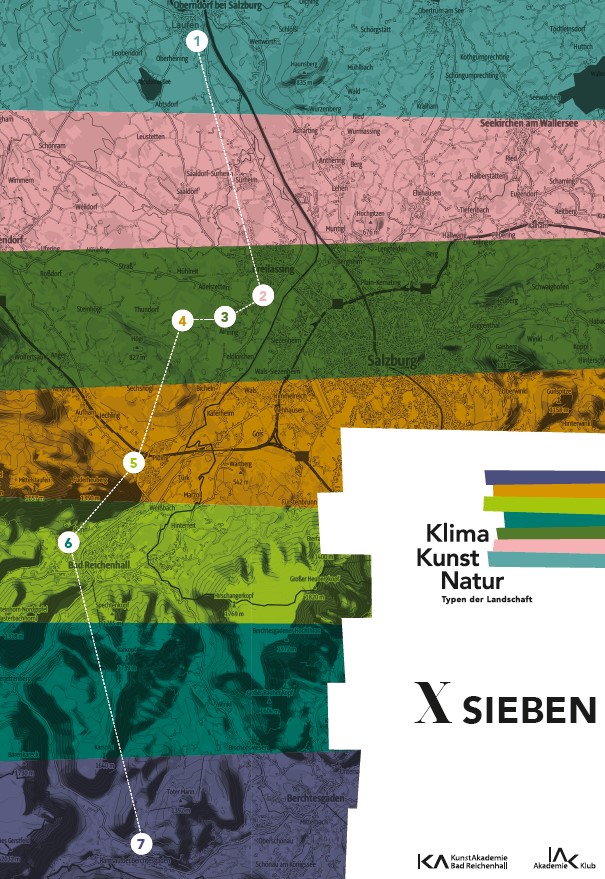
Discover the individual art projects of our CLIMATE ART NATURE project in Berchtesgadener Land until October 31, 2022:
Our aim is to get the whole of Berchtesgadener Land moving. Doesn’t awareness first have to change in order to bring about a change in behavior? No medium is better suited for this than art! This project sees itself as an impetus for a process of change in consciousness.
Art is our mediator for climate and nature!
Flyer_KLIMA KUNST NATUR_Typen der Landschaften_

STATION 1: Thorsten Schoth- Cyanometer
The trained sculptor Thorsten Schoth leads our gaze towards the sky, going back to the research findings of 18th century naturalists who tried to determine the shades of blue and thus the humidity they contained. The less moisture in the air, the deeper the blue and the greater the global warming! READ MORE

STATION 2: AIR- Budcke/Benkert- Landscapes
Can there be a landscape without a representation of it? At what point does a collection of diverse objects become a landscape? The discovery of the landscape is closely interwoven with the emergence of landscape painting. It can probably be argued that the term “landscape” was only discovered through the depiction of landscape in the form of art. Thus, the starting point of the landscape is, on the one hand, that it only becomes a landscape through the depiction itself and that it always requires man to shape, control and change nature in order to speak of a landscape WEITERLESEN

STATION 3: FOREST- Katrin Brand- infinitely valuable
With her artistic intervention in a dense forest of sticks in Adelstetten, the artist Katrin Brand declares the high value of nature. The value is very high and cannot be expressed in figures, and our economically minded society has never tried to measure it! So she herself considers the value to be no less than “infinitely valuable” WEITERLESEN

STATION 4: MOOR- Moritz Urban- Chiroptera
Offenbach-based artist and designer Moritz Urban deals with the promises of the outdoor industry to be close to nature and sustainable. In the middle of the Ainringer Moor, between tall trees and with a view of the water, he has installed a menacing bat-like object in attack flight, which looks uncanny in this environment and in its size. WEITERLESEN

STATION 5: WIESE- Korbinian Enzinger- Synthetic Swarm
Korbinian Enzinger’s “synthetic swarm” reflects the complexity of the environment and nature. His ecological perspective attempts to sharpen our awareness of our environment by means of a technical object. The central approach is to use technical objects – his synthetic swarm – to reveal our limited perspective on the environment and nature on the one hand and our simplified view of complex systems on the other. WEITERLESEN

STATION 6: AUE- Rohrmoser/Austria- Clothes
How many clothes do we own? How many do we need? Why do we change our clothes again and again, depending on the occasion, our need for prestige, our activity or the weather? Dressing is the basic theme for the artist duo from Bad Reichenhall and they have found the perfect location for a large-scale installation the size of a floodplain forest: the Nonner Au! WEITERLESEN

STATION 7: BERG- Planetary Intimacies
Planetary Intimacies (*1989) is both an artist’s name and an artistic field research project. It explores new ways of accessing the Anthropocene with installative landscape painting, experimental cartography and sensory research. Using a traditional technique, the representation of nature as a landscape painting, the artists seek to achieve not only a view, but also a networking of man and nature through an intensive and lengthy process of encountering man and nature in the natural space by painting in the landscape.
Wir freuen uns, dass Michaela Kaniber, Bayerische Staatsministerin für Ernährung, Landwirtschaft und Forsten, die Schirmherschaft des Projektes übernommen hat.
Ein Projekt der Kunstakademie Bad Reichenhall und der AkademieKlub e.V.
Kontakt:
projektleitung@kunstakademie-reichenhall.com
Projektleitung: Mag. art. Christiane Pott-Schlager
Sponsoren